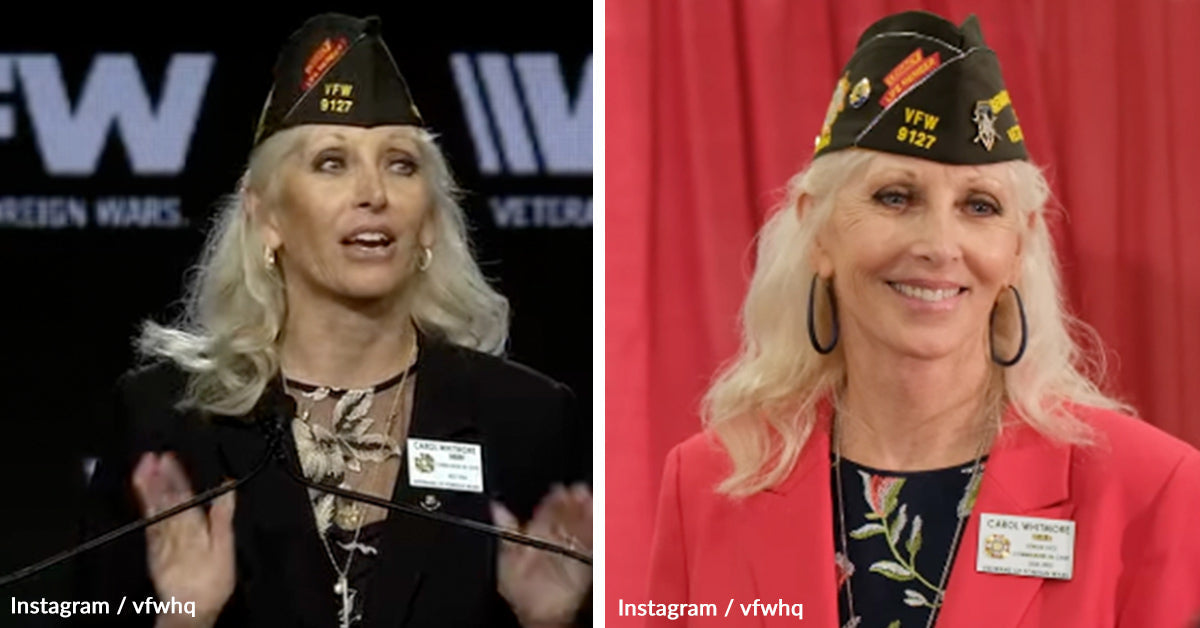
The Veterans of Foreign Wars (VFW) has marked a historic milestone with the election of its first female commander-in-chief, Army veteran Carol Whitmore. Her appointment, announced during the organization’s 126th National Convention in Columbus, Ohio, highlights a significant step forward in veteran leadership and representation. With over three decades of military service and years of dedicated involvement in the VFW, Whitmore brings a wealth of experience and a deep commitment to advocating for fellow veterans. Her story underscores the evolving role of women in the military and veteran communities, making “first female VFW commander-in-chief” a keyword phrase that resonates with both historical relevance and contemporary progress.
Modern workspace with open laptop and houseplant
Whitmore’s military journey began in 1977 when she enlisted in the U.S. Army after attending the University of Northern Iowa for three years. She candidly recalled how financial constraints led her to a recruiter’s office, where she made the life-changing decision to join the armed forces. “I did not want to incur a large debt,” she said. “I literally walked into a recruiter’s office and said, ‘Here I am. I want to sign up.’”
Closeup of hands typing on a wireless keyboard
Her service began during a pivotal time for women in the military. As part of the last cohort of the Women’s Army Corps, Whitmore transitioned into the Regular Army in 1978, an integration she described as a unifying moment. “We were all one Army at that time, finally,” she reflected. This transition marked the beginning of a 36-year career that included roles as a medic and later as a nurse, following the Army’s encouragement for her to pursue nursing school.
Throughout her career, Whitmore served in various locations including Germany, Honduras, Belize, and Iraq. Despite her extensive service, it wasn’t until 2010 that she deployed to Iraq with the 103rd Expeditionary Sustainment Command out of Iowa. Her deployment, which focused on reporting illness and injury rather than direct combat, nonetheless earned her eligibility for VFW membership. “I was very fortunate when I went to Iraq,” she said, noting her gratitude to those who had served in more dangerous conditions earlier in the conflict.
Whitmore joined VFW Post 9127 in Des Moines, Iowa, where she was warmly welcomed. “They never questioned my service, they never questioned that I was a veteran,” she said, recalling her first meeting. Her involvement grew steadily as she took on leadership roles at the post, district, and department levels. Her tenure as VFW Department of Iowa Commander from 2018 to 2019 earned her All-American status, and she later served on several national committees, including the Legislative Committee and the National Council of Administration.
Now, as national commander, Whitmore is focused on key legislative priorities and veterans’ health initiatives. One of her top goals is the passage of the Maj. Richard Starr Act. This legislation would allow medically retired veterans to receive both their full military retirement pay and their full disability compensation. Currently, those who retire due to combat-related injuries before reaching 20 years of service face a reduction in retirement pay equivalent to their disability compensation, leaving some without retirement benefits. “I want that to happen so badly I can taste it,” Whitmore stated, emphasizing the urgency of addressing a policy that has remained unresolved for 15 years.
Another focus for Whitmore is improving treatment options for veterans with post-traumatic stress disorder (PTSD). She expressed concern that current treatments often rely too heavily on medication. “They don’t want another pill thrown at them,” she said. “They want different treatments that are out there. Hyperbolic chambers are out there.” Her advocacy for alternative therapies reflects a broader push within the veteran community for more personalized and effective care solutions.
In addition to her VFW service, Whitmore has held roles on the Iowa Veterans Commission and is a life member of several veteran organizations, including the Military Order of the Cootie, the VFW National Home, and the American Legion and its Auxiliary. She and her husband, Brad, reside in Des Moines, continuing their commitment to supporting veterans at both the local and national levels.
I found this detail striking: despite serving for over 30 years, Whitmore didn’t deploy until near the end of her career. Her story challenges common assumptions about military service and highlights the diverse paths through which veterans earn their honors and eligibility. Her leadership now stands as a testament to those varied experiences and the strength they bring to organizations like the VFW.
With 1.5 million members in the VFW and its Auxiliary, Whitmore’s leadership comes at a crucial time. Her plans to advocate for legislative reforms and improved healthcare options aim to better serve a community that has long carried the burdens of military service. As the first woman to hold the VFW’s highest office, she also serves as a role model for future generations of veterans, reinforcing the importance of representation and inclusive leadership.